Vortex: Filling the Empty Quadrant Between Data Scale and Business Logic
Vortex Quantitative ·
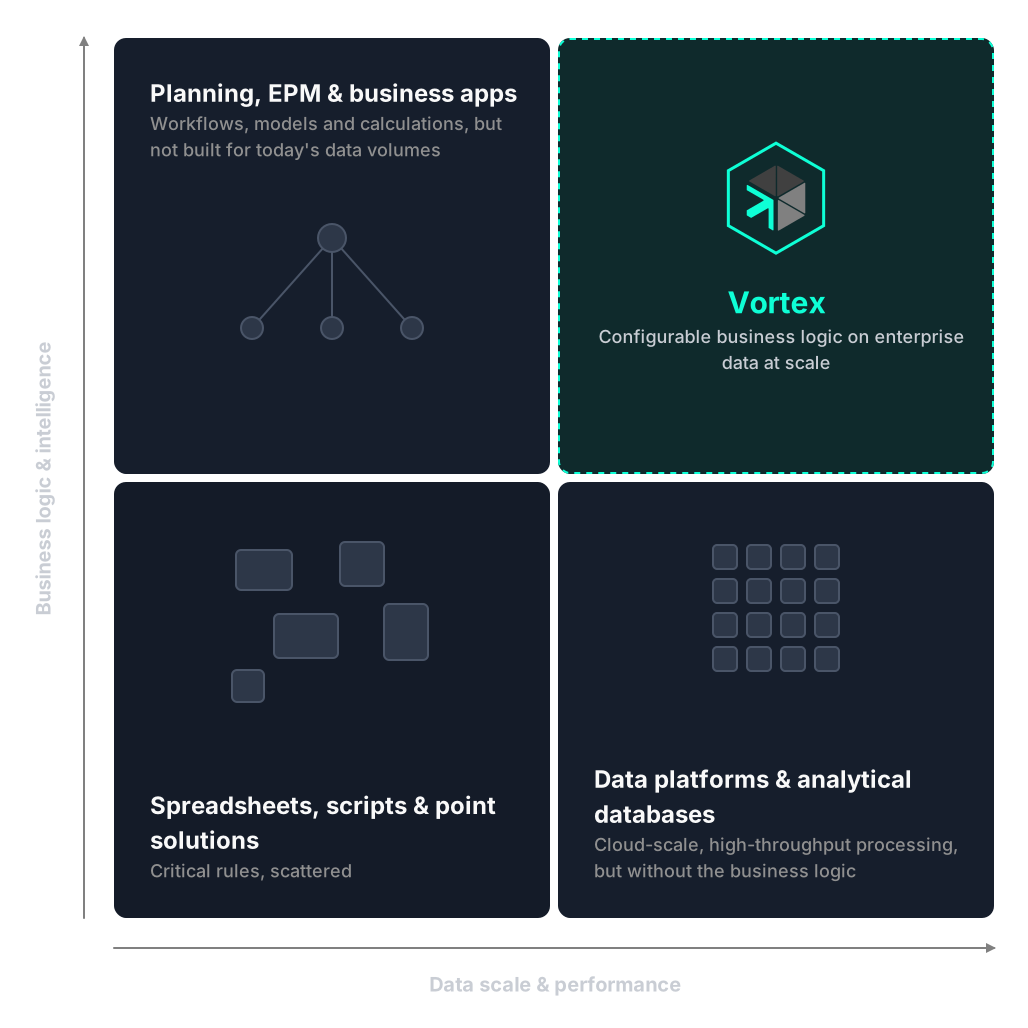
An empty quadrant has been left open where complex, flexible business logic meets high data volumes. Vortex fills it by bringing configurable business logic to enterprise data.
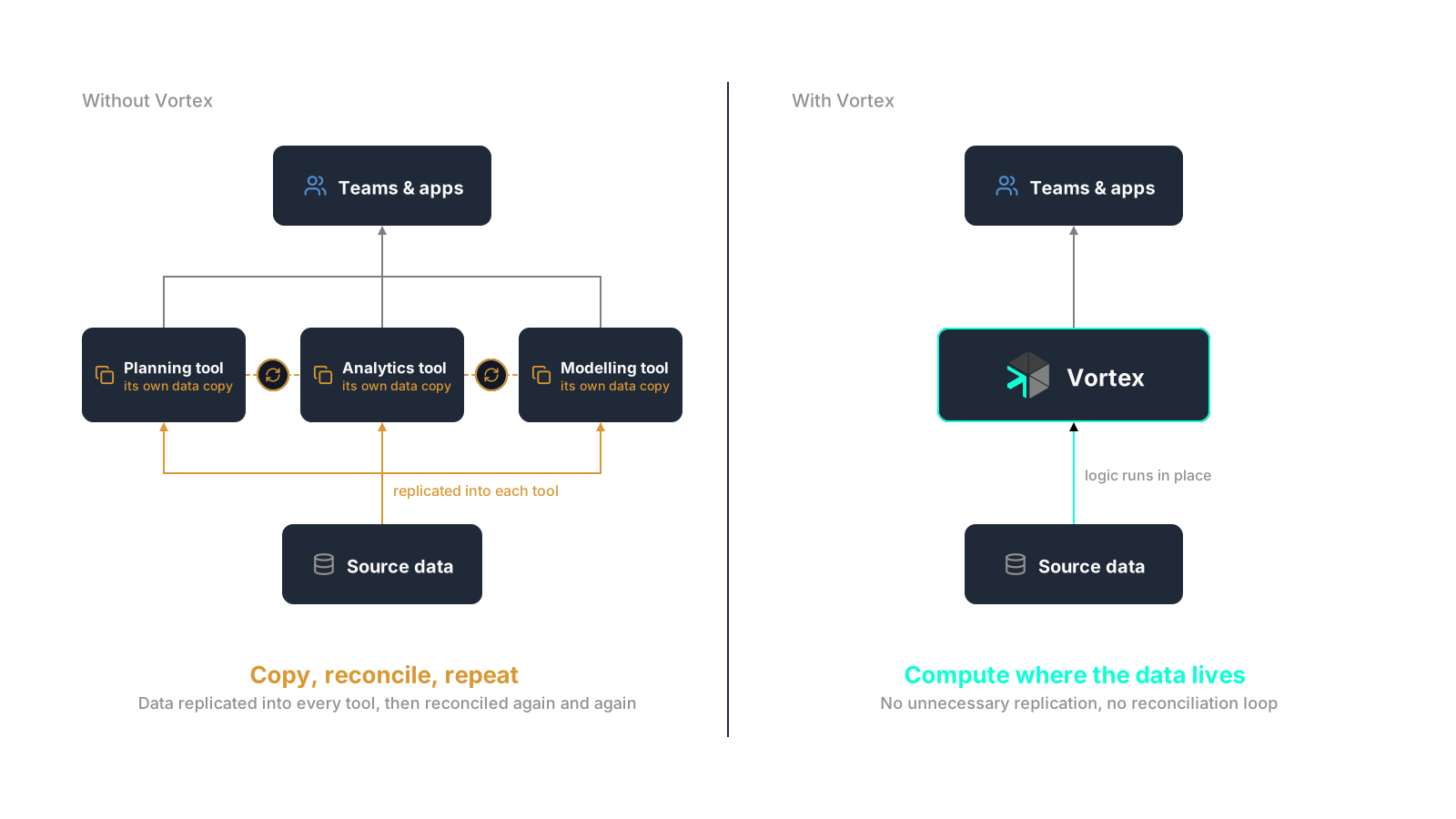
Vortex works with data where it already resides, avoiding data replication across planning and analytics systems.
For Vortex, configurable business logic at scale means running sophisticated, high-performance computations on large datasets in real time. Vortex enables this through composable Actions, governed workflows and configurable user pages.
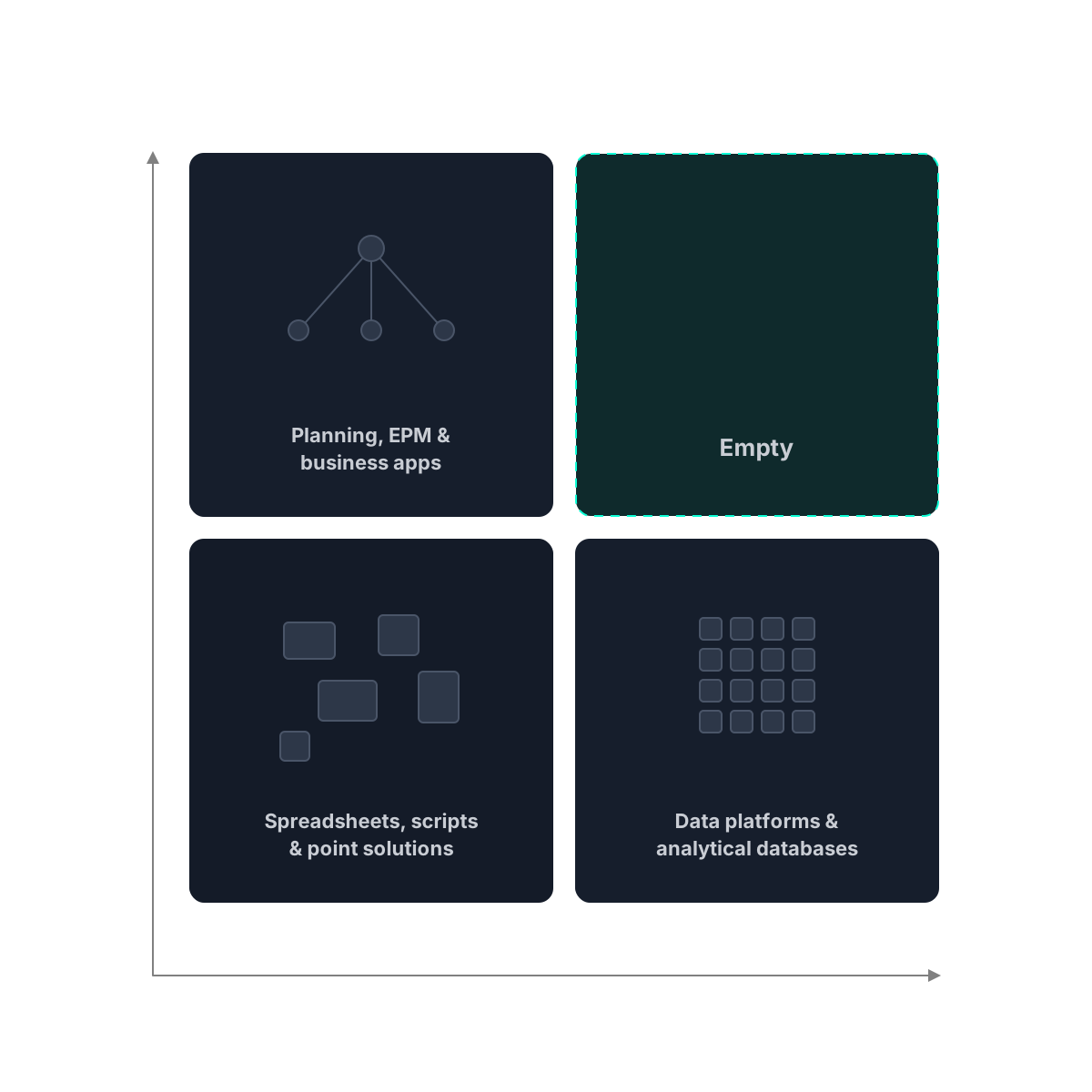
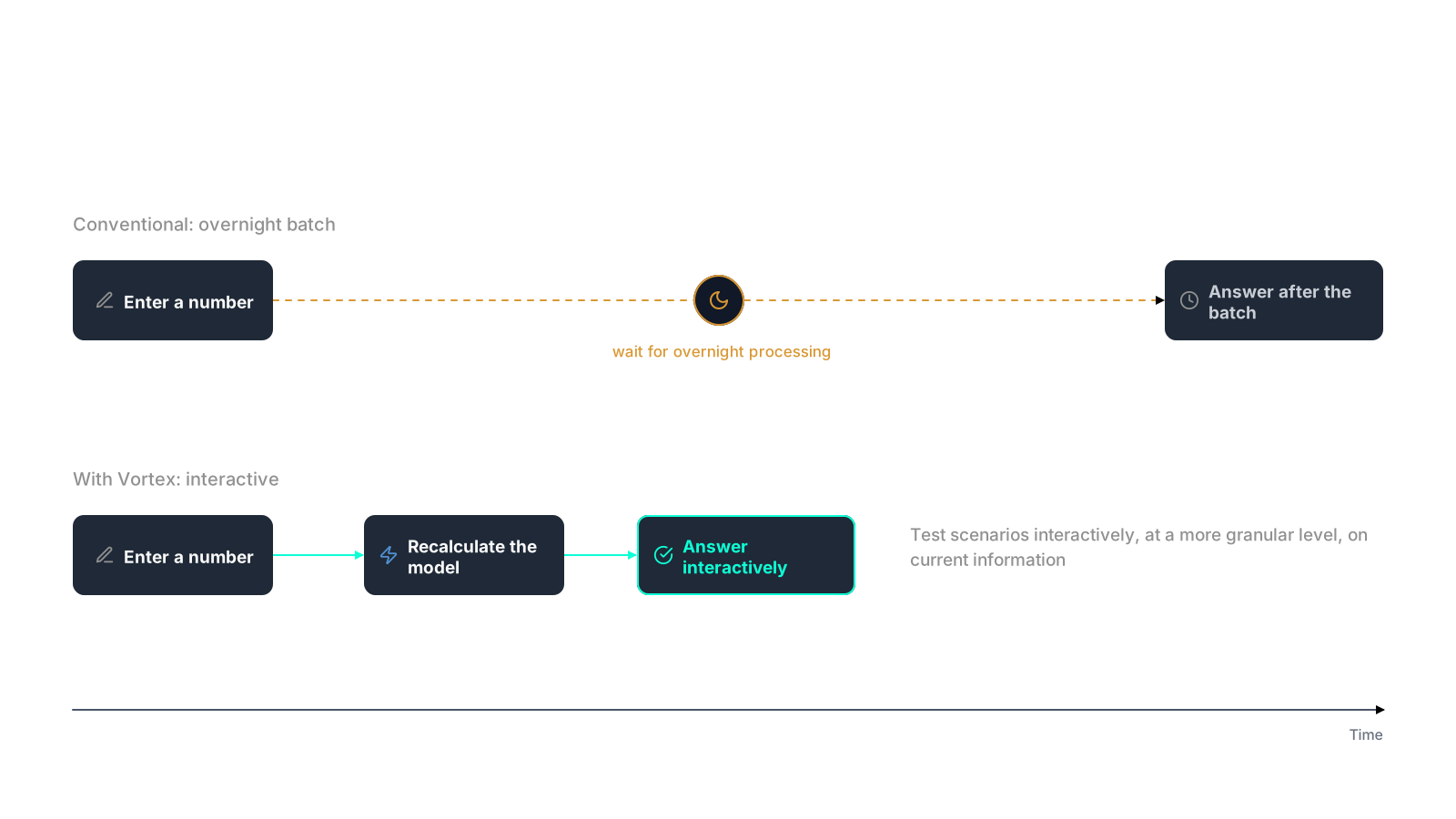
Enterprise software is increasingly expected to do two things: return answers quickly and reflect how the business operates. Performance means processing high data volumes, supporting granular analysis, and responding interactively rather than overnight. Business logic means understanding financial logic, real-world hierarchies, planning workflows, and the ability to enter a number, recalculate the model, and adapt as the business changes.
Yet much of today’s enterprise software architecture treats these capabilities as separate problems. Data platforms and analytical databases are designed to address performance, with high-throughput processing and cloud-based scalability. Planning, EPM, and business applications are designed to support business logic, with workflows, models, calculations, approvals, and user interaction. No one category has accomplished both, often leaving organizations needing several products, and several copies of the same data, to get the job done.
That leaves an empty quadrant in the enterprise software space: flexible, configurable business logic that can run on large volumes of enterprise data without requiring that data to be moved into a proprietary platform. Vortex is designed for this empty quadrant. It provides an intelligent application layer that brings business logic, workflows, and governed actions to an organization’s existing data and cloud infrastructure.
Why Enterprise Software Splits Data Processing from Business Logic
Enterprise software has increasingly split into specialized categories. Data platforms are built to store and process large datasets across cloud environments, while business applications focus on planning, modeling, approvals, calculations, collaboration, and decision-making.
Business applications were designed to deliver the logic organizations need to plan, model, approve, and act. But they were not built to apply that logic to the growing volumes of data generated in the modern enterprise. As the market evolved, organizations often bridged this gap by replicating data into application-specific environments and assembling multiple systems to create one complete process. One platform processes data at scale, another holds models and calculations, and others support planning, reporting, or operational workflows. The result is additional storage, integrations to manage, and versions of the same information to reconcile, along with a recurring trade-off: analytical scale on one side, flexible business logic on the other.
Vortex Brings Business Logic to Enterprise Data
Closing this gap requires a different enterprise software architecture: one that brings business logic to an organization’s existing cloud and data infrastructure, rather than moving enterprise data into an application-owned store. Teams should be able to configure workflows, calculations, models, permissions, and applications while retaining control over where data resides and how workloads run.
Vortex provides this as an intelligent application layer. The data plane continues to store and process data at scale, while Vortex provides the control plane: the layer where teams define, execute, and govern the business logic applied to that data. This enables organizations to build interactive applications, planning processes, calculations, and operational workflows without creating another proprietary data silo. And Vortex supports a bring-your-own-cloud model, allowing organizations to use the infrastructure they have selected for security, compliance, performance, and/or commercial reasons.
The practical impact is more than faster queries. Teams can test scenarios interactively, analyze data at a more granular level, and act on current information faster, rather than waiting for overnight processing. This matters when high data volumes, complex business logic, and responsive user interaction are all required at once.
Configurable Business Logic for Enterprise Applications
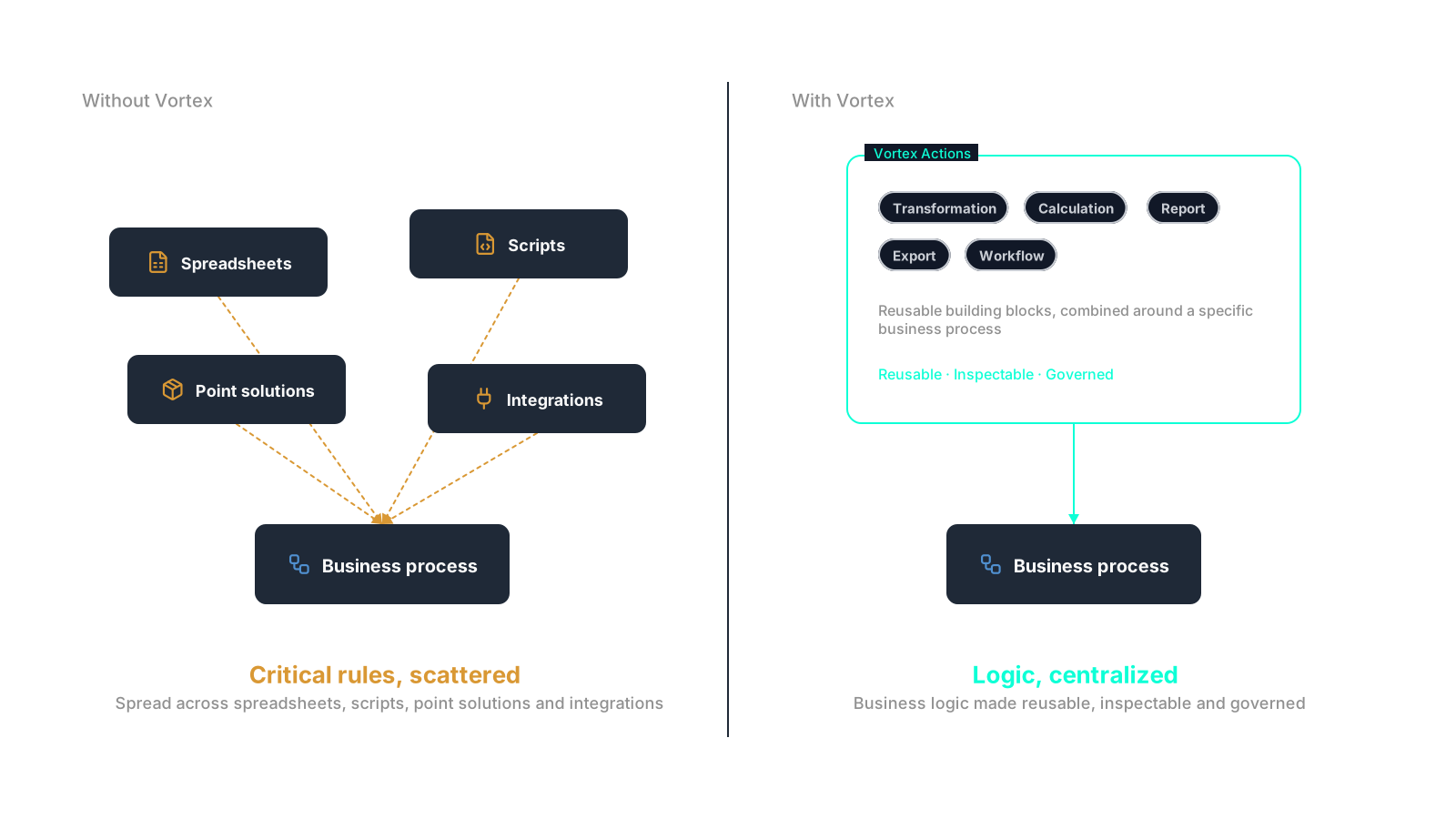
At the core of Vortex is a system of reusable Actions: modular building blocks for data transformation, calculations, reports, exports, and workflows. Teams can configure and combine Actions around a specific business process, while Vortex manages underlying complexity such as dependencies, execution order, workload distribution, and performance. This separates business solution design from low-level platform engineering.
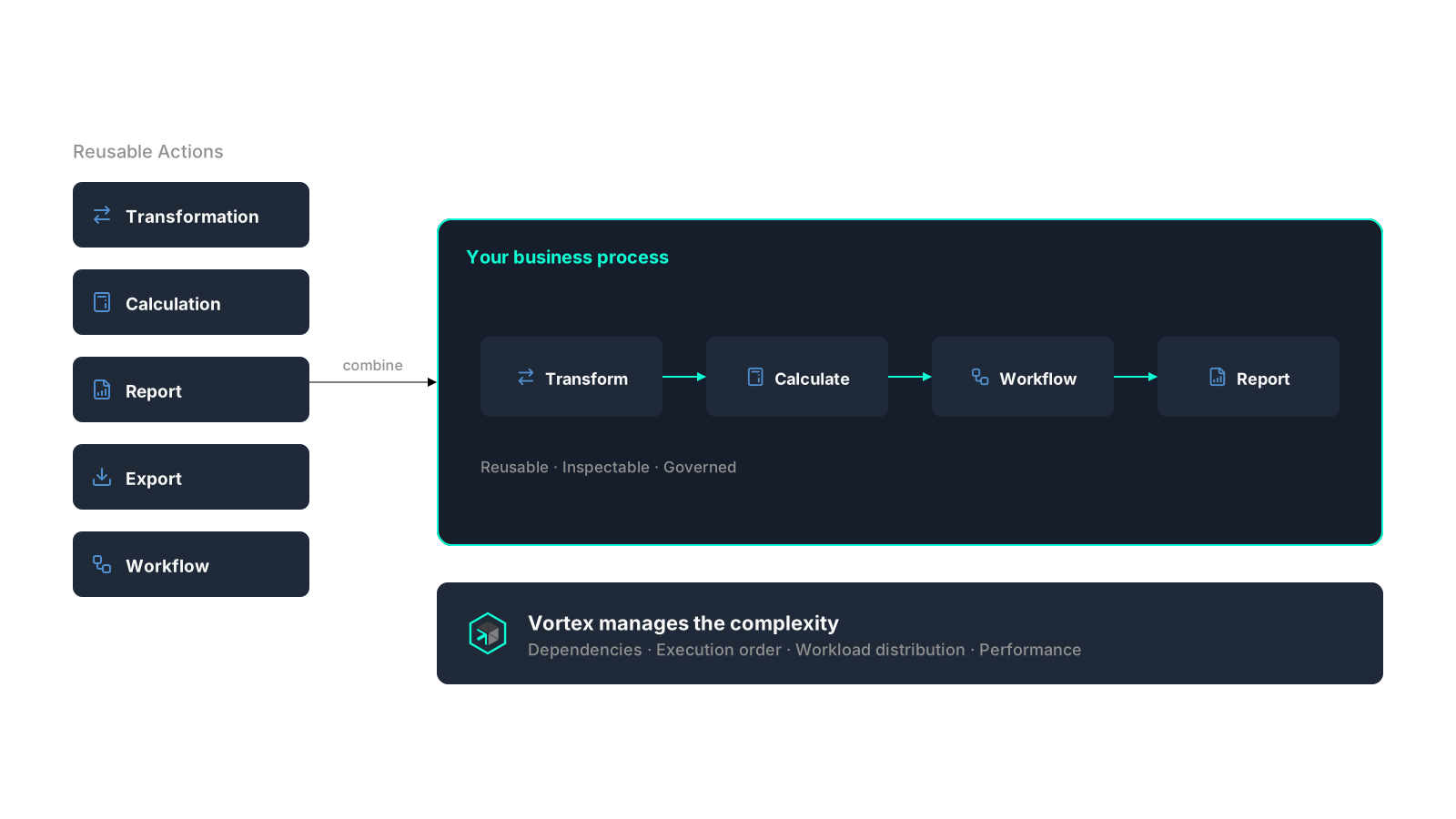
Partners and customers can focus on the domain expertise that makes an application valuable without rebuilding the technical foundation from scratch. Actions also centralize business logic. Instead of leaving critical rules scattered across spreadsheets, scripts, point solutions, and integrations, organizations can make that logic reusable, inspectable, and governed.
For a generation of enterprise planning teams, Essbase demonstrated the value of combining intelligence with performance. It brought multidimensional modeling, financial logic, hierarchies, calculations, write-back, and analytical performance together in one environment. The goal today is not to recreate a legacy cube architecture, but to preserve the insight behind it: enterprise applications need both intelligence and performance. Modern platforms can pursue that goal over an organization’s existing cloud and data infrastructure, without requiring enterprise data to be copied into another proprietary store. That is the empty quadrant Vortex is designed to fill: fast data and flexible business logic, together again.
FAQ
What problems does Vortex help enterprise teams avoid?
Vortex helps reduce duplicated data, fragmented workflows, and difficult reconciliations. It connects business logic with scalable enterprise data.
What are Vortex Actions?
Actions are reusable building blocks for calculations, transformations, reports, exports, and workflows. Teams combine them around specific business processes. Vortex manages dependencies and execution complexity.
Does Vortex require a separate data platform?
No. Vortex works with the data and cloud infrastructure an organization has chosen. This supports a bring-your-own-cloud approach and avoids creating another proprietary data silo.