From Governed Data to Governed Decisions: Extending Analytics to Planning on Snowflake and Databricks
Vortex Quantitative ·
Financial planning on Snowflake and Databricks means running budgets, forecasts and scenarios directly on your governed data, not on a separate copy. The data platform shows finance what happened; planning is how finance decides what to do next.
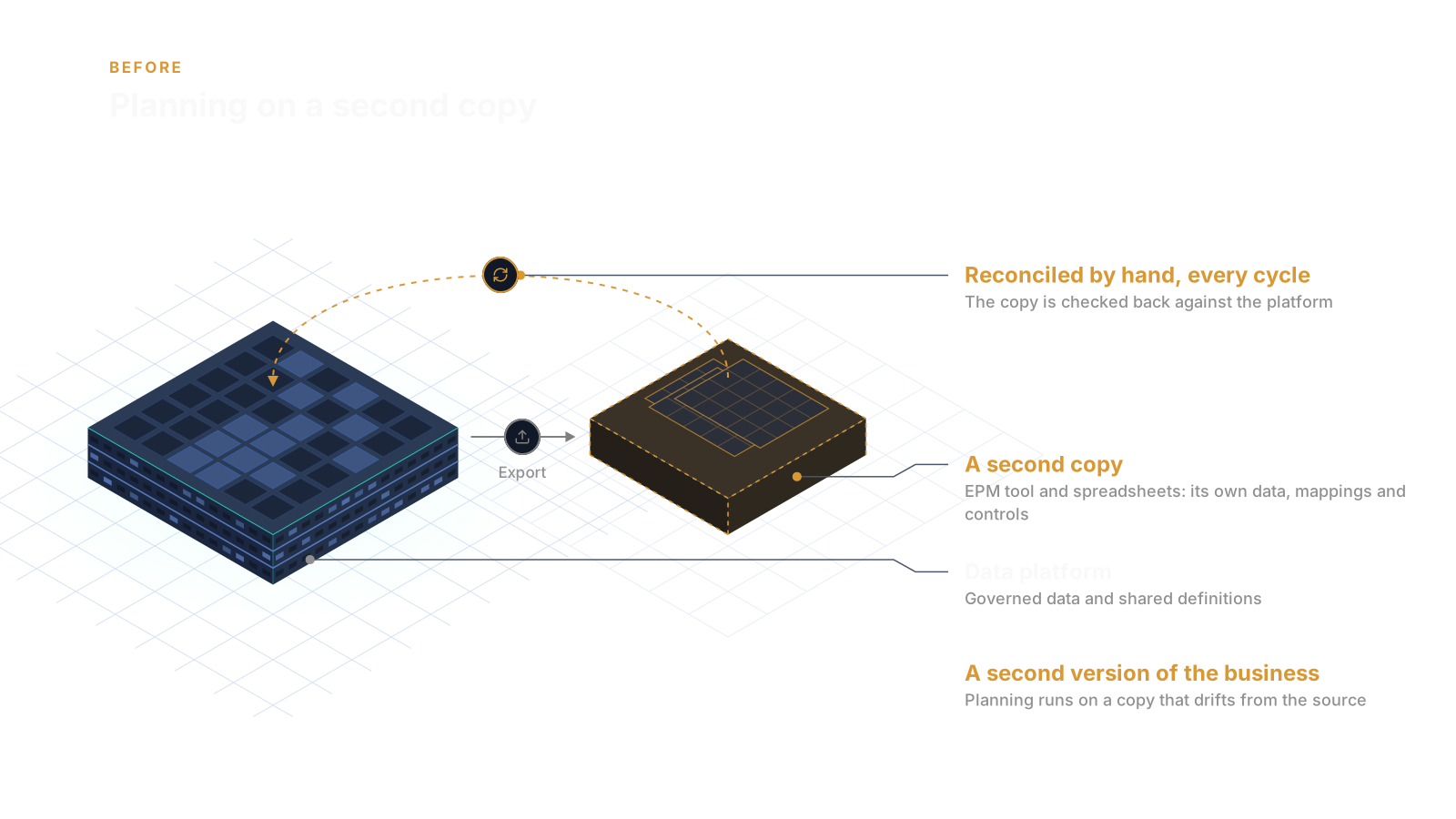
The data is centralized, yet the planning process is not. A data platform holds trusted data and shared definitions, but it doesn’t run budgets, scenarios or approvals, so finance still exports actuals into an EPM tool or a spreadsheet and builds a second version of the business.
That is the last mile: an application layer for input, allocation, simulation and approval workflows. Vortex is designed to provide all of that and more, on top of your existing data platform, so plans and AI agents work from one data foundation and one set of definitions.

Every finance leader knows what happens when the budget cycle starts: teams from across the organization pull data from a central source and begin to independently build their forecasts. The data is centralized, but the planning process is not.
Many enterprises have already consolidated financial results, operational records and master data in platforms such as Snowflake or Databricks, with common definitions and access policies on top. Then the budget cycle starts, and finance exports it all into an EPM tool or a spreadsheet. Now there’s a second version of the business, with its own mappings, its own calculation logic and its own controls.
Finance still needs a planning model. Building one shouldn’t require a second data foundation.
The hidden cost of the finance data mart
Take a headcount forecast. Employee records, compensation, cost centers and actual spend may already sit in your enterprise data platform. Copying them into a planning data mart means maintaining another refresh schedule, along with the mappings between employees, departments and accounts.
When an employee moves departments or a reporting hierarchy changes, the planning model needs to catch up. A compensation update that misses the nightly extract leaves finance working with an outdated baseline, and another reconciliation task before the forecast can be trusted. When every planning process starts with an extract, reconciliation becomes routine rather than an exception.
Semantic layers define the numbers, not the decisions
Snowflake Semantic Views and Databricks Metric Views give measures, dimensions and relationships a consistent definition, so tools work from one set of business definitions instead of rebuilding them for every question.
That’s a solid foundation for FP&A. Actual revenue should mean the same thing in the forecast. But defining revenue doesn’t set next quarter’s pricing assumptions, and defining personnel cost doesn’t decide when to fill a vacancy. Planning needs more: editable assumptions, allocations, calculation dependencies, scenarios and approval workflows.
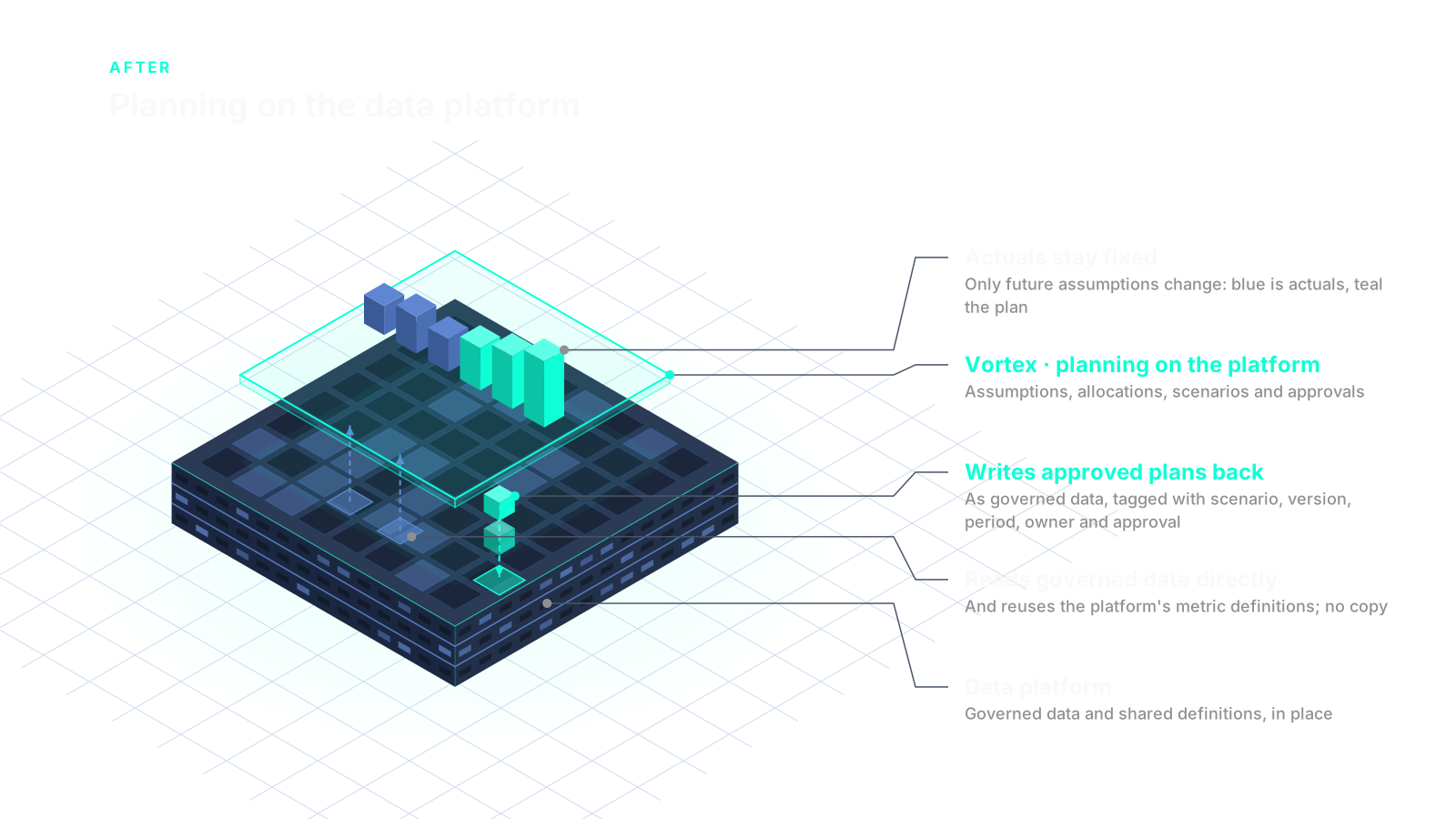
None of this means making historical data editable. Actuals stay fixed. What becomes actionable are future assumptions, still tied to trusted definitions.
Vortex defines the business logic on the data lake
Vortex is an intelligent application layer that operates on top of existing infrastructure, with configurable Actions, multidimensional computation and an interaction layer for business processes. Applied to the planning challenge above, the architecture is built around three objectives:
- Read governed source data directly. Planning should not depend on a separately maintained data mart.
- Build on existing metric definitions. Reusing Semantic Views or Metric Views avoids duplicating or reinventing business logic inside the planning model.
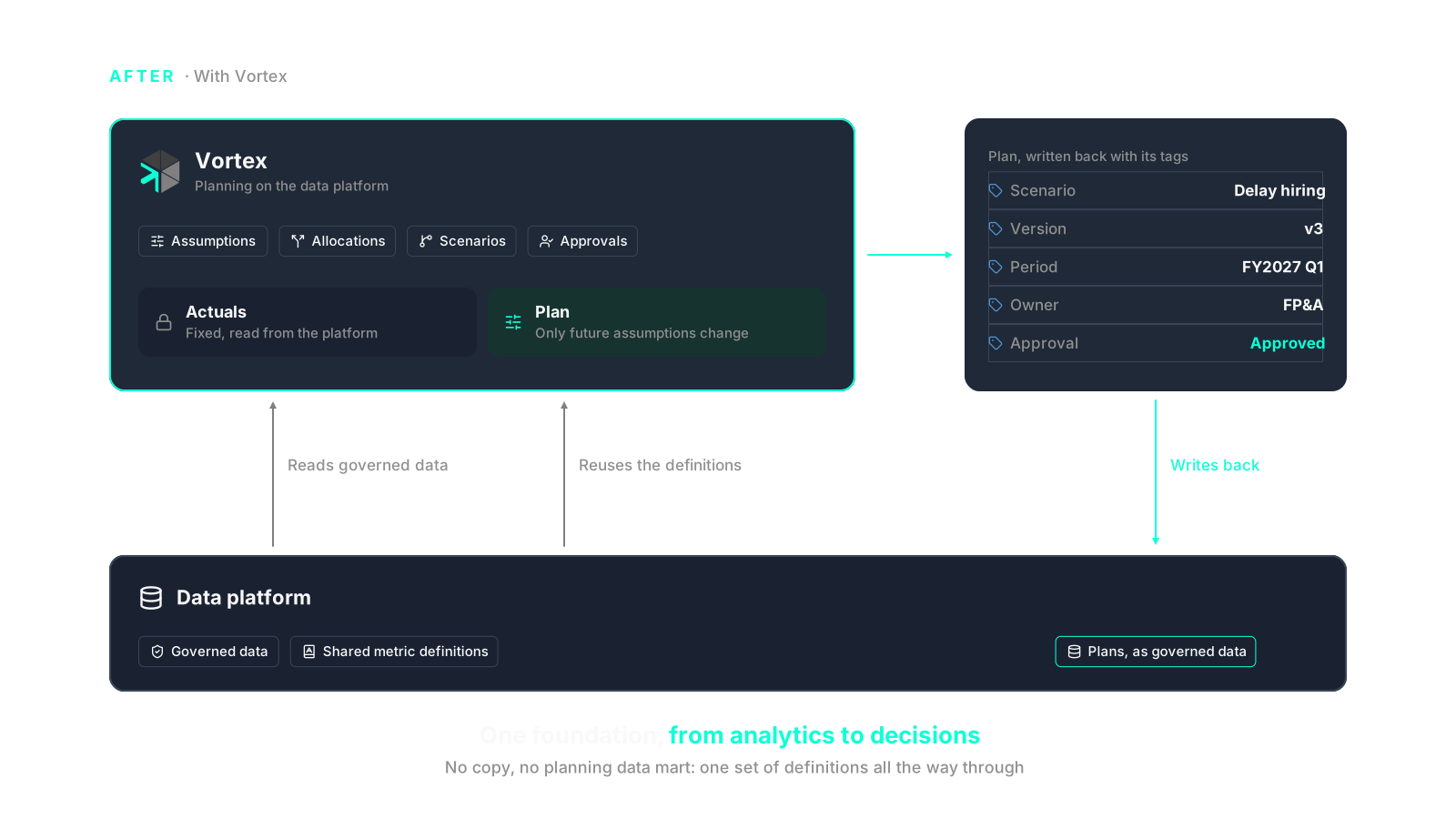
- Publish approved plans back as governed data. Outputs return to the platform as identifiable, controlled datasets, not detached exports.
The outcome is a single foundation for actuals and business definitions, with separate, controlled versions of future scenarios alongside it.
Write-back turns scenarios into usable enterprise data
Write-back is more than saving a revised number. It’s what makes a plan part of the enterprise record.
Take a manager modeling a 5% reduction in regional spend. Because Vortex operates directly on top of your data lake, they evaluate this scenario using the lake’s original semantics. When the plan is ready, there are no manual hand-offs or disjointed data exports. Instead, the entire lifecycle – modeling the scenario, routing it for approval, and submitting the finalized numbers – is governed by one single, secure workflow.
When the approved results return to the data platform, Vortex automatically writes them back into the exact native structures and semantics required by the data lake. The data arrives carrying its full context: scenario, version, period, owner, and approval status. A useful planning output isn’t just writable; it is natively structured and immediately traceable for any authorized user.
From answers to actions: AI agents that plan
While tools like Databricks Genie and Snowflake Cortex excel at answering questions through semantic context, planning requires action.
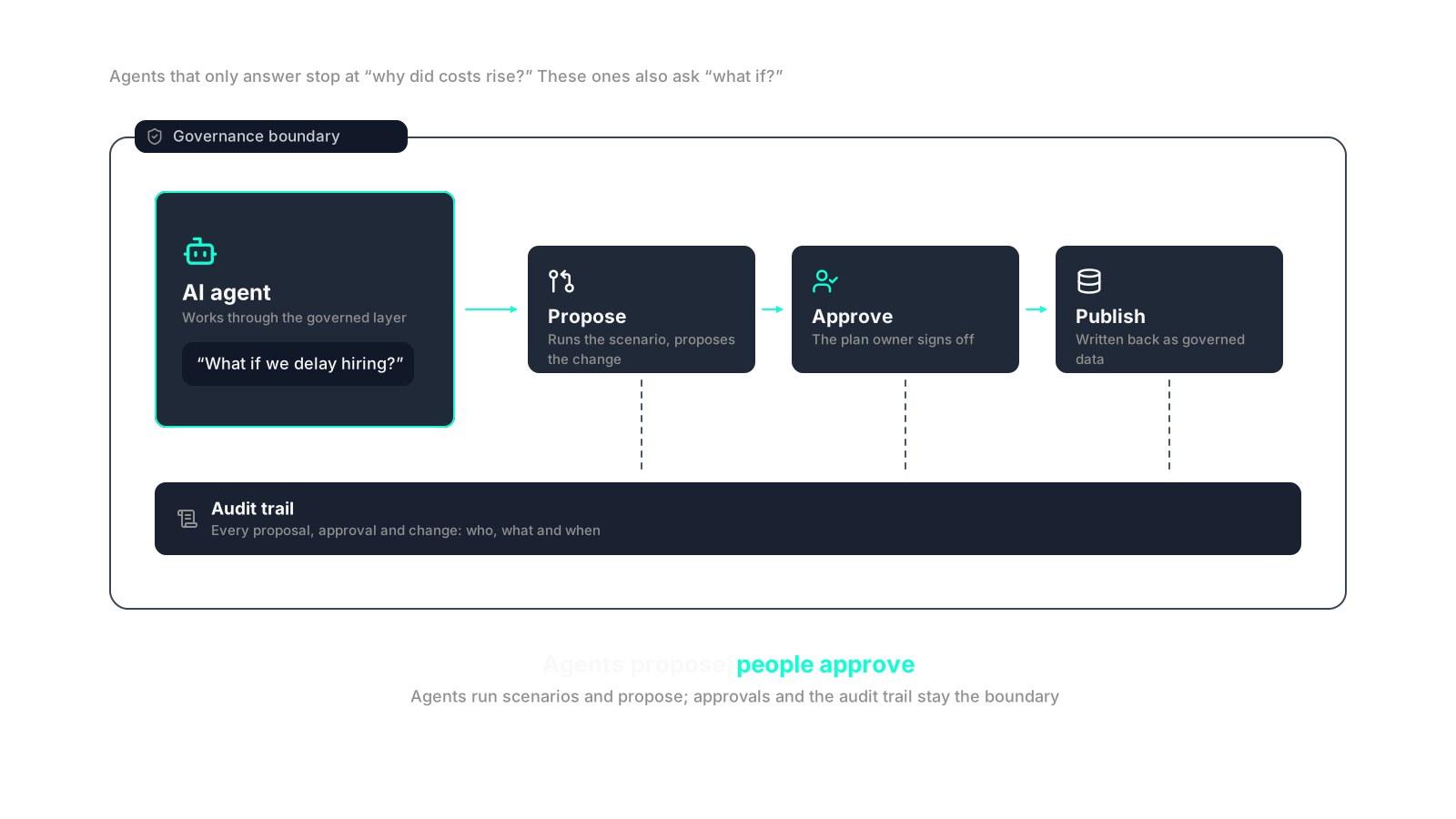
“Why did costs increase?” needs an answer; “What if we delay hiring?” needs a simulation.
Because Vortex keeps planning logic in one governed layer on the data platform, finance doesn’t need a separate application for each planning process. On this foundation, Vortex’s MCP (Model Context Protocol) layer lets AI agents run scenarios and propose plan changes.
Operating as governed users, agents can adjust assumptions and calculate impacts to compare options. However, governance remains the boundary: agents propose changes within a structured workflow with strict approvals and audit trails, ensuring they act as a trained colleague rather than a tool with limited context and process awareness.
What this means for the CFO and the CDO
For the CFO, it means speed and one version of the truth: a shorter path from a change in assumptions to a financially coherent, enterprise-wide response, with no reconciliation between a mart and the source.
For the CDO, the data platform gets its highest-value use case. Governed data stops only explaining past performance and starts supporting future decisions, with plans that finance, data teams and AI agents can all work from.
FAQ
What does planning on a data lake mean?
It means connecting planning models and workflows to the existing enterprise data foundation, so finance does not need to maintain a separate copy of source data.
Do semantic layers provide planning capabilities?
No. Semantic layers define business meaning. Planning requires editable assumptions, calculations, scenarios and approval workflows.
What is write-back in financial planning?
Write-back records planning inputs or outputs in a designated data store. Controls keep working scenarios separate from approved plans and historical actuals.
How can AI agents support financial planning?
Agents can invoke authorized planning operations to test assumptions and compare scenarios. Approval and publication remain subject to explicit permissions, workflow rules and general audit.
Can you use your data lake to replace planning tools and applications?
No. While a data lake holds trusted data and shared definitions, it doesn’t run budgets, scenarios or approvals. That is the last mile: an application layer for input, allocation, simulation and approval workflows, which Vortex is designed to provide on top of your existing data platform.